Let’s face it: besides “let’s take this offline,” the word culture is one of the most overused pieces of corporate jargon. And if you’re in any sort of people operations role, it’s practically written in your job description to uphold a strong team culture. But how exactly do you do that in a way that feels right for your team without being cringe?
On Slack’s design team, we provide the space and support for our designers to work together to create our team’s culture through the Culture Squad. Every six months, designers on the team volunteer to take part in our Culture Squad pods:
- Connections Pod: Looking at how to build meaningful connections as a team both virtually and IRL. This can include organizing in-person hangs, AMAs, and virtual events!
- External Awareness Pod: Examining new ways of amplifying our external presence via our social media outlets like Instagram and LinkedIn, articles for this blog, videos, podcasts, and more!
- Learning Pod: Creating informative and inspirational learning opportunities for the Design team, like brown bag sessions, workshops, interviews, and more!
My role is to empower our designers to redefine what it means to connect, learn, and show up as Slack Design. This summer, our learning pod was up for the challenge! After throwing the rule book about traditional learning models out of the window, they created a new program called  Design Moves.
Debunking traditional learning models
Traditional tech L&D models bring in an external subject-matter expert to talk or facilitate a seminar, but those guests may not understand the unique intricacies of your company or team. Or you do monthly workshops, biweekly brown bags, or other all-day team learning events that have a more one-and-done approach. You and your coworkers learn something, but then you may barely talk about it again, if ever! We aimed to challenge the usual approaches and do something different. By putting all of our team in the driver’s seat — our team is full of experts — and crowdsourcing plenty of varied content for an entire week, we were ready to take learning to a whole new level. Bonus: We used Slack  to bring the program to life, including using features like clips, huddles, and canvas.
Thus, Design Moves was born: a themed weeklong fun extravaganza of knowledge sharing, discussion, doing, and prizes, centered around a core skill of design. Our pilot week was on the theme of Storytelling. We picked storytelling as our initial theme because storytelling is a critical skill for every designer; good storytellers build alignment through clarity, conciseness, and making the abstract concrete.
Our goals:
- To create buzz and get the team excited. We wanted this to feel like an experience, so we created our own Design Moves branding and a curated box filled with storytelling essentials delivered to designers’ doors the week before kickoff.
- To have varied content throughout the week, both live and asynchronous. This included virtual AMAs with company leaders, panel conversations, clips, challenges and contests. Our #design-moves channel was poppin’ throughout the week!
- To leverage the superpowers of everyone on our team. We have designers who are so good at visualizing data, designers who can take command of an audience, and designers who know how to bring humor into their presentation. We wanted to give them a platform to share their expertise.
- To build on the content by creating structure. This meant packaging the content into the various stages of storytelling, including setup, process, and delivery!
- To make it fun! We had contests throughout the week where designers nominated their favorite Humor Hero, Wordsmith Wizard, and Persuasion Pro from within the team.
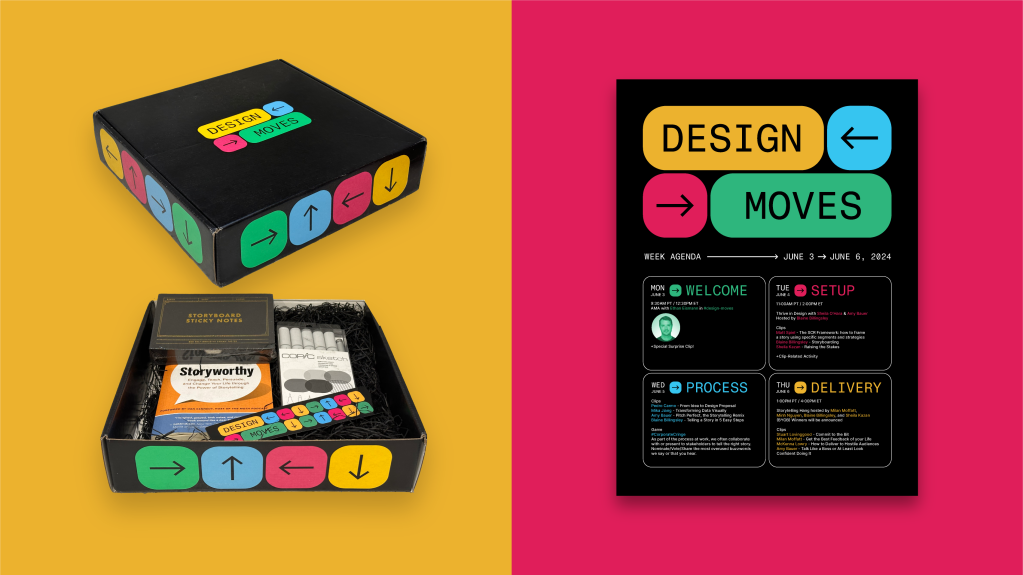
We designed unique branding for the program, including a special swag box with all your storytelling essentials.
The benefits of crowdsourcing knowledge from within your team
What made this initiative truly special is the number of designers — from leaders to ICs — who contributed to the cause. Between designers who submitted clips, featured panelists, our internal storytelling winners, and everyone who engaged with the content throughout, this was an all-hands-on-deck operation. We even had Slack CEO Denise Dresser send a personalized message to the team on the importance of storytelling to kick things off.
We learned that crowdsourcing L&D from within your team works for so many reasons, but here are just a few:
- You’re capitalizing on the internal talent you hired specifically for their perspective, intelligence, and breadth of different experiences from different parts of tech (via previous jobs and roles). Internal talent is often an overlooked and untapped resource in L&D.
- Bringing a diversity of knowledge and experience to L&D was far more informative than bringing in one or two external subject-matter experts.
- There’s inherent trust and excitement in learning from people you already know and work with (as opposed to “Who exactly is this stranger we’re bringing in to speak to us, and why?”).
- It creates a sense of pride by sharing something you’re good at with the team, especially a skill others may not know you possess.
- Everyone already knew the intricacies of our team and our values of being humble, curious, diverse, and empowered. The content was also tailored specifically for our team.
- An asynchronous experience meant that more designers could participate and we didn’t have to play calendar war.
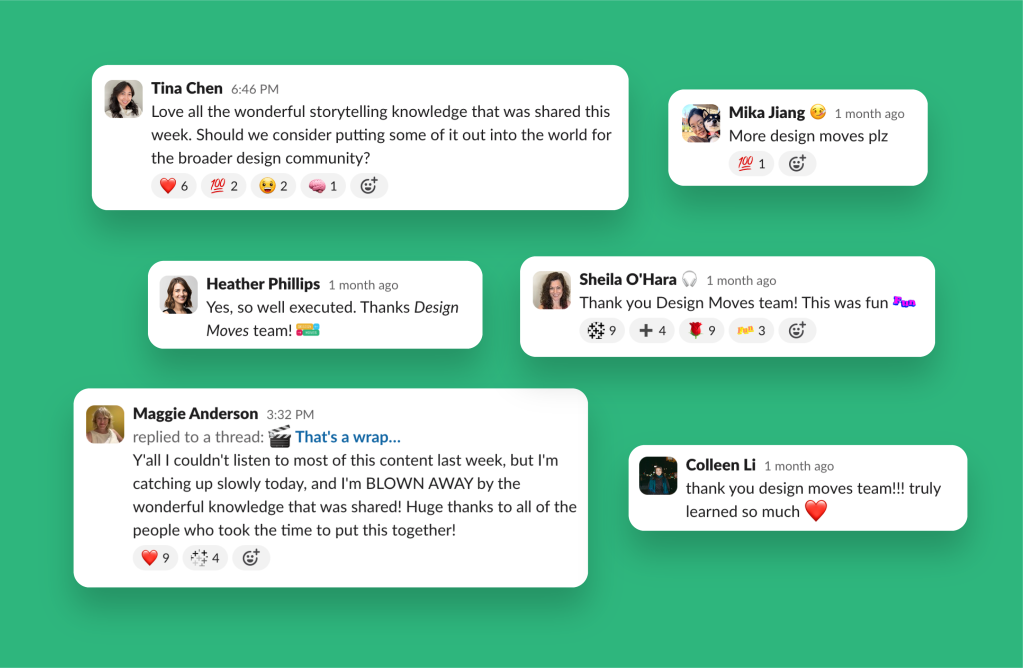
We received so much positive response from the team in our various internal design channels.
Creating momentum around a core skill
Design Moves was inventive and it created energy around storytelling. Even after our Design Moves finale, there was so much chatter in various channels where designers were referencing storytelling in some way or mentioning a good storyteller at Slack and beyond. Other departments in Slack started reaching out after hearing about it, wanting to emulate the same format within their teams. And as one of our designers said, “I find myself thinking about storytelling. I still find myself contemplating multiple presentations now, a week after the event!”
As a bonus, all of the content now exists as a living artifact that designers can go back to and reference in a nicely structured canvas.
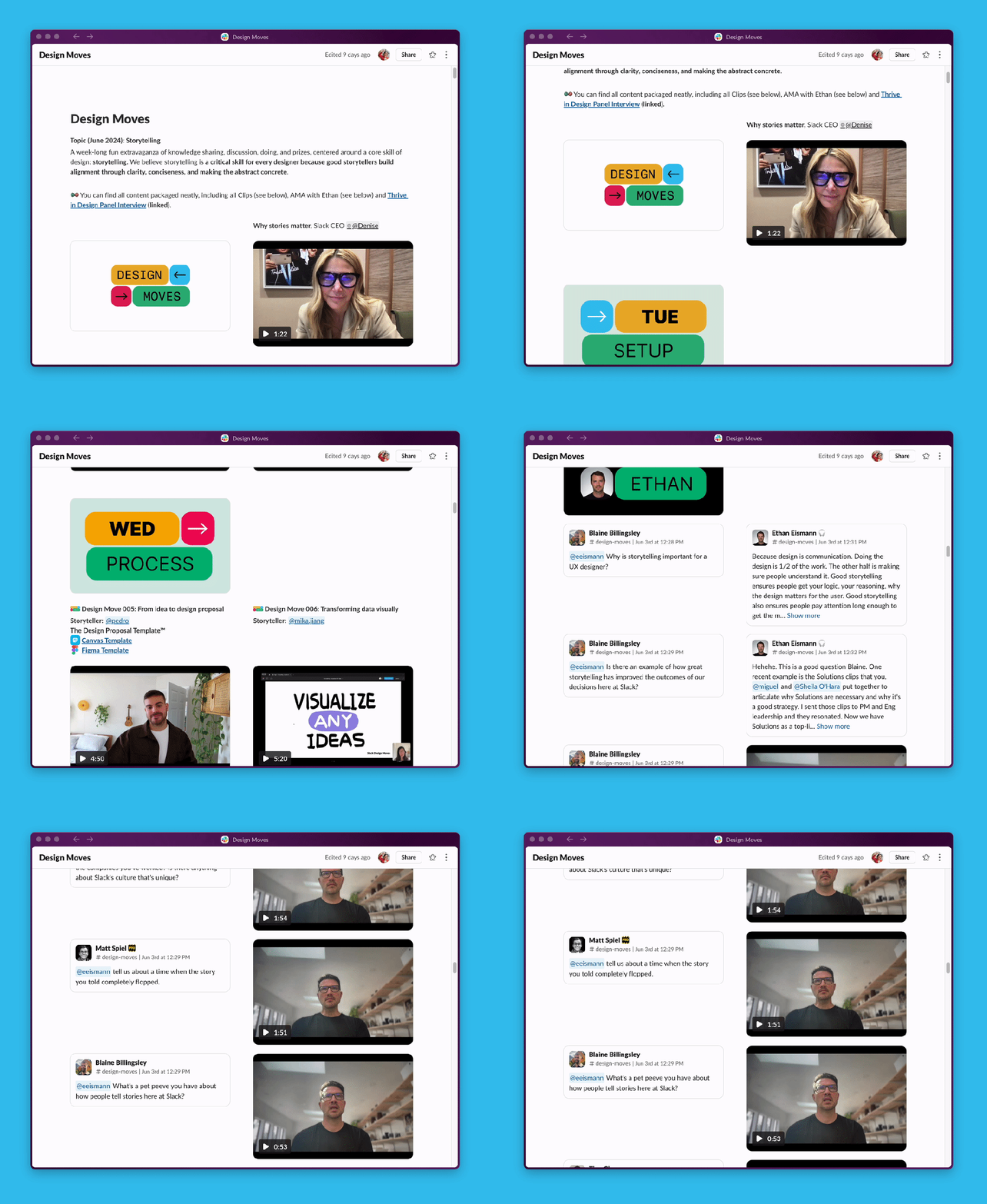
All the storytelling content now lives in a canvas for our team to reference the next time they are telling a story.
And to think this all started when we encouraged our designers to think outside the box! Thank you to Blaine Billingsley, Milan Moffatt, and Minh Nguyen for being the best partners in crime.
Now, what should our next Design Moves topic be? 
The post How we developed a better way to learn at Slack Design appeared first on Slack Design.